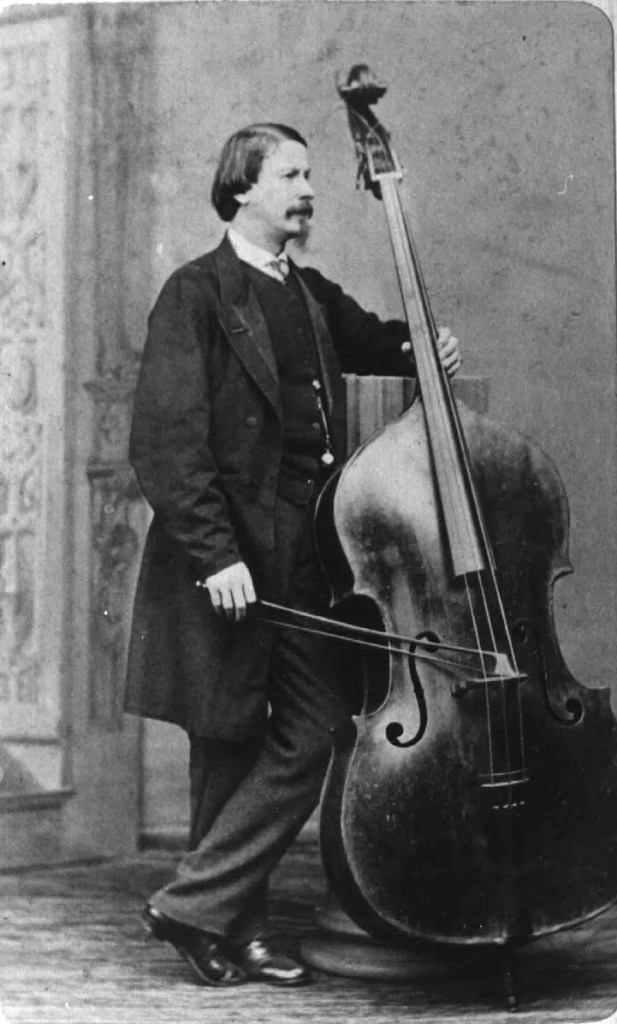
Giovanni Bottesini (1821–1889) is a name most double bassists speak with a mix of awe and exasperation. But while most biographies repeat the same points (Venetian conservatory prodigy, opera conductor, globe-trotting soloist), Bottesini’s life holds stranger and lesser-known corners worth exploring.
1. He Almost Didn’t Play the Bass
Bottesini only auditioned on the double bass because the Milan Conservatory had one last-minute scholarship left — and it happened to be for that instrument. Before that, he was a violinist and timpani player. Had another instrument’s scholarship been free, the double bass world might never have had its greatest 19th-century champion.
2. His First Bass Was Bought With a Lottery Prize
At age 19, Bottesini won a modest sum in a local lottery. Instead of saving it, he bought a double bass made by Carlo Giuseppe Testore — the same instrument he would play for most of his career, and which shaped his signature sound. Today, that Testore is as famous among bassists as his compositions.
3. He Was Also a Conductor of Grand Operas
Many forget that Bottesini was a highly sought-after conductor. In fact, he conducted the première of Verdi’s Aida in Cairo in 1871 — a fact overshadowed by Verdi himself. Bottesini and Verdi were close friends, bound by their shared Italian musical roots and a certain flair for drama.
4. He Composed in Hotel Rooms and on Steamships
Bottesini’s touring life was relentless — Europe, the Americas, the Middle East, Cuba. With no fixed home, he composed on the road, often sketching arias and bass cadenzas in cramped hotel rooms or even aboard steamships crossing the Atlantic.
5. He Wrote Operas (and One Is a Murder Mystery)
His operas are rarely performed, but one in particular, Ero e Leandro, is a lush romantic tragedy, while Ali Baba is an exotic adventure. Even more intriguing is Cristoforo Colombo, which blends historical narrative with mysterious political intrigue — far from his bass showpieces.
6. His Technique Was Considered “Impossible” by Peers
Many contemporary bassists dismissed Bottesini’s solos as freakish stunts that nobody else could or should attempt. Ironically, today’s bass students still wrestle with his thumb position arpeggios, harmonics, and sweeping portamenti — proving that Bottesini’s technical revolution still challenges the modern hand.
7. He Died the Same Year as His Friend Verdi’s Otello
In 1889, the year of Bottesini’s death, Verdi premiered Otello. Bottesini didn’t live to hear Falstaff, but both composers had, by then, reshaped Italian music in very different ways: Verdi with operatic drama, Bottesini with the elevation of the double bass to a solo voice.
Why He Still Matters.
Bottesini was more than a flashy soloist. He was a musical cosmopolitan, an artistic entrepreneur, and a restless spirit who brought the double bass into the limelight when few thought it belonged there. Remembering these lesser-known facts helps us see not just the myth, but the man — a musician who, quite literally, bet on the bass and won.
1835–1839: The Budapest of an Unexpected Virtuoso
- Bottesini turned violinist after winning a double bass scholarship at Milan Conservatory—thanks to availability, not inclination—after four hasty lessons.
- He purchased the iconic Carlo Giuseppe Testore bass in 1838 for 900 lire; it nearly sat unused backstage before becoming his lifelong companion.
1840s: From Solo Talent to International Sensation
- First public recital in Crema in 1840, followed by triumphs in Vienna and beyond.
- Touring Cuba as principal bassist, he captivated audiences during opera intervals, solidifying his soloist reputation.
1844: Innovating with the Gran Duo Concertante
- Premiered his Gran Duo Concertante for two double basses in Venice with fellow student Arpesani; its two-bass structure was highly novel.
- Later arranged with violin and performed across the Americas and Europe with virtuosi like Sivori.
Mid-1800s: Concertizing and Composition
- Authored 14 operas including Cristoforo Colombo, Ali-Babà, Vinciguerra, Ero e Leandro, and diverted output to chamber works like 11 string quartets and quintets featuring bass.
- Composed around 48 pieces for double bass among over 250 total works.
1871: Opera & Empire
- Chosen by Verdi to conduct the premiere of Aida at Cairo’s Khedivial Opera House on 24 December 1871.
- In a surreal gesture of spectacle, Bottesini financed and staged exotic animals—including elephants and camels—onstage during Aida’s Triumphal March.
1888–1889: Culminating a Storied Career
- On Verdi’s recommendation, Bottesini became director of Parma Conservatory in 1888; he died there in 1889.
- Buried in Parma’s Cimitero della Villetta, alongside Paganini—a fitting finale for the “Paganini of the Double Bass.”

 Diego Robledo
Leave a comment